PoWiFi devices can tap into RF (radio frequency) signals emitted by transmitting towers and wirelessly recharge mobile phones in the remotest of areas. Here’s all you need to know.
Wouldn’t it be great to have a device that harvests energy from thin air and uses the energy to wirelessly recharge your cell phone batteries? No more bulky cell phone rechargers, no more panicky situations when your cell phone battery ‘dies’ and you are ‘disconnected’ from friends and family, and no more running around looking for an electrical recharge point.
If Shyamnath (Shyam) Gollakota, Assistant Professor and Head of the Network and Mobile Systems Lab, Department of Computer Science and Engineering, University of Washington, is to be believed, coming soon is a device that will make cell phone chargers a thing of the past.
As cities get smarter or WiFi enabled, more and more people will be using WiFi at offices and homes. Today, wireless communication is extremely well established and millions of people, especially in the West, rely on it every day. India too is catching up.
It is precisely this huge WiFi infrastructure that Gollakota is very excited about. More WiFi means more RF signals, which in turn means more ‘energy harvesting from thin air’.
A prototype device, the size of a credit card, that is the brainchild of Gollakota and his young team of researchers, called PoWiFi (or Power over WiFi), is making waves around the world, literally speaking.

Shyam Gollakota with his PoWiFi prototypes.
Photo: www.eecs.mit.edu
Still in its infancy, PoWifi has been demonstrated to wirelessly recharge a 2.4V nickel-metal hydride (NiMH) and a 3.0 V lithium-ion (Li-Ion) coin cell battery at a distance of up to 28 feet, and also communicate with battery-free temperature and camera sensors with ranges of 20 and 17 feet respectively. This, by the way, is just the tip of the proverbial iceberg because there is more to come.
In a recent paper describing their work,
Powering the Next Billion Devices with WiFi, the researchers provide a detailed description of how they have successfully powered devices wirelessly, such as cellphone batteries, temperature and camera sensors using existing Wi-Fi routers, without reducing the routers’ performance to receive and send signals. It’s a win-win situation, as PoWiFi harvests energy while you continue to use your laptops and other devices with the same router.
PoWiFi uses the principle of Ambient Backscatter, by absorbing and reflecting ambient RF signals; the prototype devices can harvest energy and also communicate between themselves and will, someday soon, even link to the Internet.

PoWiFi prototypes
Photo: www.washington.edu
The prototype PoWiFi device has been demonstrated to have amazing capabilities, besides wirelessly recharging mobile phone batteries (currently only coin type batteries).
The device could wirelessly transmit enough power to make a simple camera sensor work; it actually took grey scale pictures of a Rubik’s cube placed almost 17 feet away. And that’s not all, PoWiFi does not have to be in the line-of-sight, it could trigger the camera through walls too. And here comes the astonishing part — Gollakota’s team further demonstrated that, if the camera sensor does have a rechargeable battery, PoWiFi could wirelessly recharge the battery too.
As computing devices become smaller and more numerous, powering them becomes more difficult; wires are often not feasible, and batteries add weight, bulk, cost, and require recharging/replacement that is impractical at large scales.
Gollakota is now looking far into the future — he envisages a number of functions that PoWiFi can perform, such as, becoming a wireless charging hotspot for FitBit and Jawbone activity trackers.
Many poorer parts of the world lack reliable electricity sources but are beginning to have strong cellular coverage. Gollakota believes that a PoWiFi device could tap into RF signals emitted by transmitting towers and wirelessly recharge mobile phones in the remotest of areas.

Shyam Gollakota has a B.Tech from IIT Madras, and an M.S and PhD from MIT.
Photo: blog.josemandojana.com
For Gollakota, his journey has just begun; he’s got a long list of devices, a billion at least, for PoWiFi to power up. And he’s happy to be ‘harvesting energy from thin air’ to do so.
Then there is “the Internet of Things” where billions of sensors, cameras and other data-gathering gadgets and related services will eventually monitor, analyze and manage the world; they will all of course need electricity to function.
This is where Shyam Gollakota has set his sights on, teaming up with his colleague Joshua R Smith, and three of his research students; they have set up Jiva Wireless. Smith was a former Intel researcher who joined University of Washington in 2011. Smith was earlier known for his work on energy harvesting, such as figuring out how to power devices by drawing on the energy produced by TV broadcasts.
Shyam Gollakota has a B.Tech from IIT Madras, and an M.S and PhD from MIT. Gollakota has won numerous awards; he was named in Forbes 30 under 30 and in Technology Review TR35, Innovators Under the Age of 35, 2014. He has also won the Alfred Sloan Research Fellowship 2015 and the NSF Career Award 2015. His other areas of research are Wireless Gesture Recognition and WiFi imaging.
Vedant, a Class 6 student, is not like other children his age. He plays with LEDs, diodes and magnets and dreams of making a free power source for the country. As of now, he has successfully developed an LED power source from scratch by recycling a discarded laptop battery.
Ever had your laptop battery replaced? What did you do with the old one – store it in some corner, or dispose it with the regular garbage?
While many of us struggle to find a way to discard our dead laptop batteries in an eco-friendly manner, this 11-year-old boy from Maharashtra has found a brilliant way to actually use them.
Moreover, his idea can help hundreds of people in Indian villages who do not have access to electricity.
Meet Vedant Dhiren Thaker, a Grade 6 student of Shantinagar High School, who, unlike other children his age, spends a major part of his day thinking about ways in which he can provide free electricity to the country. In his quest, armed with his love for all things electronic, he has designed and developed a power source which has been made from scratch with a recycled laptop battery.
Vedant is a resident of Mira Road, a Mumbai suburb. Every year during summer and Diwali vacations, he goes to visit his paternal village Tintoi, situated in the Aravalli district of Gujarat. That’s where some of his best friends live. Twice every year, he spends about 15 days with them, and this village is one of most important reasons behind his motivation to invent free power sources. He has witnessed first-hand how children belonging to financially weak families in the village are unable to study at night because there is not electricity.
While he carries kites, clothes, games, and crackers for them during every visit, his bigger plan is to help them study as much as they want to, despite the state of electricity in the village.
“It hurts to see that my friends cannot study after dark. I am also worried about how people in the village cook when there is no electricity. There is a risk of them getting hurt and I want to change that,” says Vedant.
And he has found a way. In January 2014, the battery of his father’s laptop stopped working after a year of use. Vedant wanted to find out what’s inside the battery, so he opened it. A laptop battery pack usually consists of 6 to 8 cylindrical lithium-ion (Li-ion) cells. On breaking into this one, Vedant found that only one of the 6 cells was not working. The rating of one cell was 3.7 volts and 2.2 amperes. All the others were functional but since the cells in this pack were connected in a series and one of them had stopped working, power supply to the others was also restricted. To his father’s surprise, he used one of the remaining functioning cells and installed it in a dysfunctional CFL inverter lamp which then started working perfectly.
After this, he further refined the idea and developed a functional light source from scratch.
How does it Work?
(At this point, we would like to sound a Geek Alert! Please proceed as your own risk)
The materials required for the light are as follows:
• A pen/pencil box
• Strips of LED lights
• A solar panel
• 3 Li-ion cells from inside a laptop battery pack
• A diode, switch and connector
Inside the box, the cells are connected to the LED strips through a connector and a switch. During normal operation, the switch is closed so that the battery can supply power and illuminate the LED.
When he reached this point, it struck Vedant that there are no charging sources in villages. Hence he thought about one of the best available renewable energy sources – solar energy. His father got him a working solar panel, which he was lucky enough to find at a scrap store. To charge the cells, a direct current output voltage line from the solar panel is plugged in the connector. It hence supplies the output voltage from the solar panel to the cells. Another challenging thought at this point was what if there is a reverse current flow from the battery? To avoid this, Vedant added a diode to the circuit, between the solar panel and the battery, so as to prevent reverse current flow from the battery to the solar panel during the charging process.
And this gives us a power source developed from the use of functional Li-ion cells of a discarded laptop battery pack, with the added feature that the cells can be recharged. All of it done by an 11-year-old!

“Even though such batteries cannot be used anymore for laptops, they still have a lot of residual charge left. This residual power can be used to light up lives of children living in extreme rural areas. The cost will also be small as the battery, which is the heart of this system, comes without any cost,” explains his father.
Ask Vedant how he knows all of this, and he smiles.
“When I was little, I used to ask my father about how everything works. What is this? What is that? He told me everything and I started understanding about electronic products since then,” he says.
His father, Dhiren Thaker, agrees that Vedant has always been an inquisitive kid.
“Ever since he was 5, he showed immense interest in the functioning of electronic items around the house. He used to break some electrical equipment at home and build something new from it. He also dissected his electronic toys part by part. Sometimes, he used to reconstruct them so I wouldn’t scold him,” he remembers.
Cells, dynamos, motors, magnets and other such things have always been his favourite toys.

With them, he constructed many things like an electronic toy boat made from scrap at the age of 7, a sound producing device when he was 6, a remote operated boat at 11, and the latest — a remote operated door unlocking system. He does not take any additional classes or read additional books for this.
Dhiren has also got a provisional patent for the power source. For this, he had to show proof to the patent attorney that the entire work has been done by Vedant. The patent will be live in one year.
Dhiren, who is a computer engineer by profession, also has an interest in electronics. He was like Vedant. That’s the reason why he has lots of extra electronic items in his house. Lucky for Vedant!
“He always seemed to understand things which are not easy for other children of his age to understand. Like how to connect cells and the way their positive and negative polarities work. He often takes me to the scrap shop and wants to purchase things with which he can create new products. He also has a good understanding about safety and is always careful about what should be touched with bare hands. Honestly, I can say that he was born with this knowledge,” Dhiren concludes.
Vedant wants to become an engineer when he grows up, so he can develop a free power source for the entire country. We hope all his dreams come true.
This “virtual team” of young Indian innovators came together from across the world at the UNESCO-AIRBUS Fly Your Ideas competition and took home the “real” prize, making the country extremely proud.
You could call it the “Winning Vibes”! That is because their winning idea was all about harvesting energy from the natural vibrations of aircraft wings.

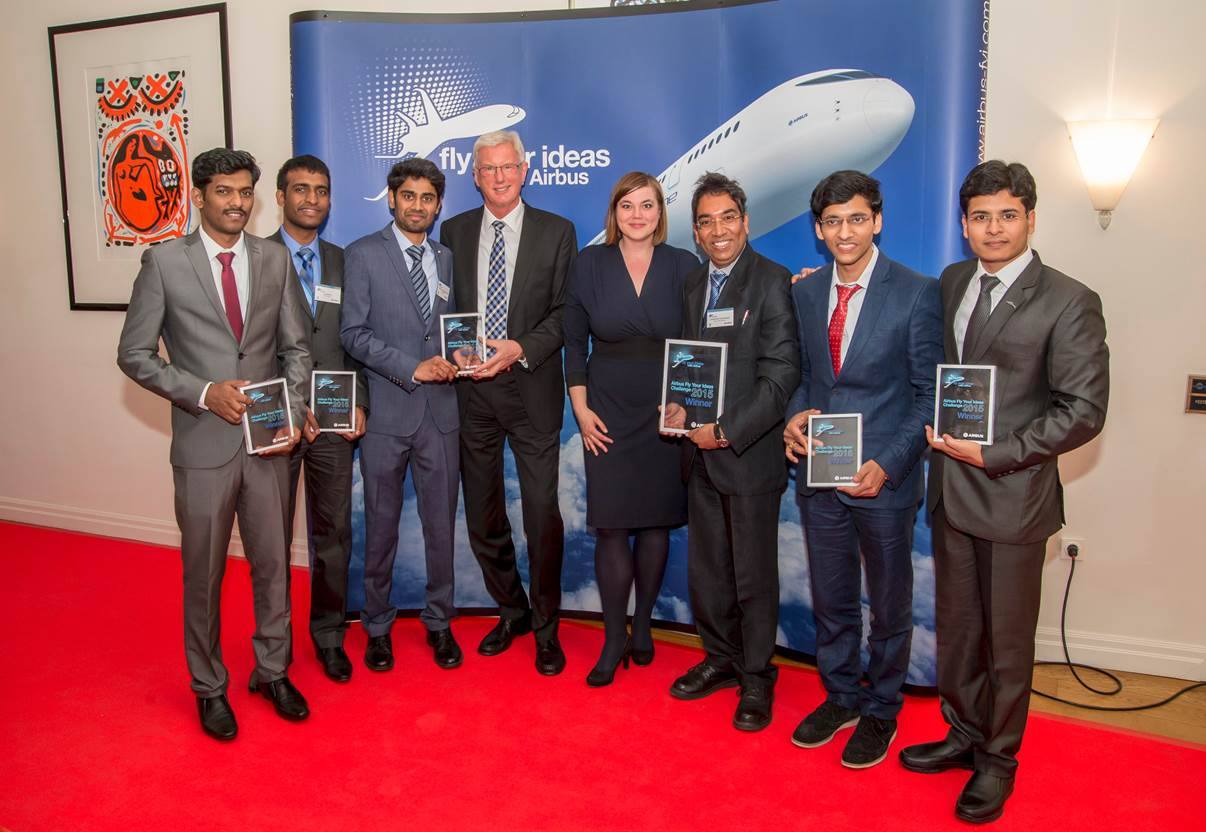
Left to Right: Veeraswamy Dhamotharan, Ajith Moses, Satishkumar Anasuya Ponnusami, Prof Dineshkumar Harursampath, Shashank Agarwal and Mohit Gupta
A team of five young Indian innovators (who called themselves ‘Team Multifun’), mentored by Assistant Professor Dineshkumar Harursampath from the Aerospace Engineering Department, Indian Institute of Science (IISc), Bengaluru, have won this year’s UNESCO-AIRBUS Fly Your Ideas (FYI) global student competition, which was recently held in Hamburg (Germany). As well as receiving the coveted trophy, Team Multifun was awarded a cash prize of €30,000 at the award ceremony in Hamburg.
Their winning project was entitled “A Hybrid Battery-Piezoelectric Composite Structure for Next Gen Aircraft”.
Photo credit: Youtube
Currently spread across four continents, the winning team comprised of team leaderSatishkumar Anasuya Ponnusami, (M.Sc Aerospace Engineering , IISc), currently pursuing his PhD at the Delft University of Technology, Netherlands; Damotharan Veerasamy (M.Sc Aerospace Engineering, IISc), currently pursuing his PhD at City University, London;Shashank Agarwal and Ajith Moses, currently pursuing their PhDs at the Nonlinear Multifunctional Composite Analysis and Design (NMCAD) laboratory, Aerospace Engineering Department at IISc, under the guidance of Assistant Professor Dineshkumar Harursampath and Mohit Gupta, who was an Indian Academy of Sciences Fellow at the NMCAD lab at IISc. Gupta is currently pursuing his M.S at Georgia Tech, USA.
“Team Multifun’s winning ideas is all about good vibrations. The team’s idea entails aircraft wings dressed in a composite skin that harvests energy from natural vibrations on flex in the wings. Piezoelectric fibers gather electrical charges from even the smallest movements during flight, storing the energy generated in battery panels integrated in the fuselage and using it to power auxiliary-in-flight systems, such as lighting and entertainment systems. This reduces the energy footprint of aircraft during flight and could even replace the entire power source for ground operations,” said an official press release from Airbus Fly Your Ideas (FYI).
According to an official Airbus article,
Dhamotharan said “Airbus Fly Your Ideas has been a wonderful platform for young researchers like us to showcase our innovative skills. And I personally felt the Fly Your Ideas challenge is designed in such a way that, throughout the competition, it keeps us with full of energy, enthusiasm and motivation to achieve the goal.”
The team’s Airbus Mentor, Deniz Oezol, says that the team’s “inspiring passion and drive for this project were simply astonishing!”
The UNESCO-AIRBUS Fly Your Ideas competition
Launched in 2009 jointly by UNESCO and AIRBUS Industries, the Fly Your Ideas (FYI) is a biennial event, set up to inspire young people and urge them into contributing to the future of a more sustainable aviation industry and to engage them in the search for innovative ideas to support this vision. FYI is designed to identify and encourage next-gen innovators to uncover futuristic and unconventional, yet promising, solutions for flight evolution. Up till now, over 15,000 students from about 600 universities and more than 100 countries worldwide have participated in the FIY competition.
The genesis of the award-winning idea

Airbus visualization of the idea
Even though they are across continents and in different time zones, the young innovators, the ‘Virtual Team’ as they like to be called, incubated their winning idea interacting with their mentor Prof Dineshkumar Harursampath at IISc. The winning five are all ex-students of Dineshkumar.
The team first zeroed in on the theme for their project. Each year has themes for the competition. For this year, the themes were: Energy, Efficiency, Affordable Growth, Traffic Growth, Passenger Experience and Community Friendliness. They chose Efficiency.
Video-conferencing was to become their sustenance; they discussed ideas, made preliminary drafts, exchanged notes and ran it through their mentor at IISc in Bengaluru. Having worked at the Nonlinear Multifunctional Composite Analysis and Design (NMCAD) laboratory at IISc was an added advantage, for it was here that they were exposed to a multi-disciplinary approach to research.
After months of fine-tuning, they finally arrived at their award winning project, “A Hybrid Battery-Piezoelectric Composite Structure for Next Gen Aircraft”. Submitted upon completion, under the leadership of Satishkumar Anasuya Poonsami in December 2014, the team was now officially termed “‘Team Multifun’ – from the Delft University of Technology, Netherlands”.
Making to the finals
A total of 518 multi-disciplinary teams, representing 3,700 students from 104 countries submitted projects for Fly Your Ideas 2015 and Team Multifun was one amongst them. Making it through the preliminary rounds, Team Multifun was joined by four other finalists: Team Birdport from the University of Tokyo (Japan), Team Aft-Burner-Reverser from Northwestern Polytechnical University (China), Team Retrolley from the University of São Paulo (Brazil) and Team Bolleboos from City University London (UK).
It was just before the final round that the members of Team Mulifun physically met, where they were joined by their IISc mentor, Prof Dineshkumar Harursampath and their Airbus Mentor, Deniz Oezol, who helped put final touches to their project.
The final teams presented their innovative concepts to a prestigious jury of Airbus and Industry experts, led by Charles Champion, Airbus Executive Vice President – Engineering.
And the winner is..

Left to Right: Dhamotharan, Ajith, Sathiskumar, Dr. Flaig, Head, Airbus Research and Technology, Ms. Fegebank, Senator (Science & Research) and second Mayor,Hamburg, Prof. Harursampath, Shashank and Mohit
On 28 May 2015, Team Multifin was declared the winner of the fourth edition of Airbus Fly Your Ideas global student competition, organized in partnership with UNESCO to encourage the next generation of innovators and uncover future solutions for the future of flight.
Beginning as a ‘Virtual Team’, these 5 proud young India Innovators, studying in universities spread across four different continents, in reality, took home the prize.
As is it said, “the sky is the limit” and so it was, for these bright young Indian innovators and their mentor, Professor Dineshkumar Harursampath.
Like this story? Or have something to share? Write to us: contact@thebetterindia.com, or connect with us onFacebook and Twitter (@thebetterindia).